

Some of the most meaningful things in our lives don’t arrive perfect.
They arrive with a past.
When we rescued our dog, we didn’t know exactly what we were getting. We knew her story only in fragments—where she had been, what she might have experienced, what she’d lost along the way. What we did know was that she needed a home, and that something about her felt worth choosing.
At first, she was cautious. She watched more than she moved. She learned the rhythms of the house slowly, carefully, as if testing whether this place was real. Over time, something changed. The house wasn’t just a place she stayed—it became hers.
Now she greets everyone at the door. She settles quietly into the background when friends gather. She has her favorite spots, her routines, her unspoken role in our home. She doesn’t just live here. She belongs here.
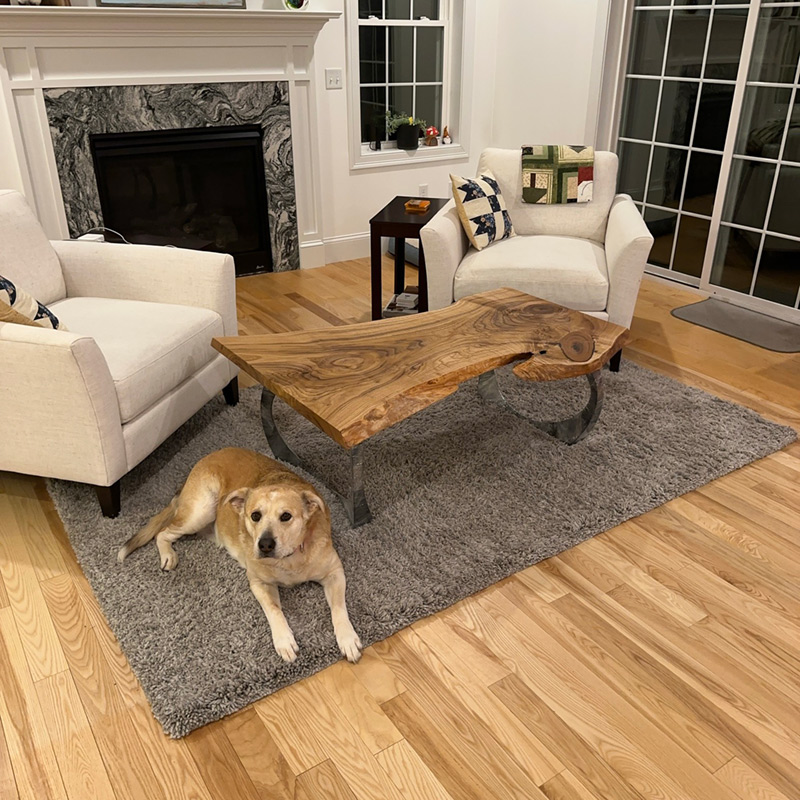
That feeling—the quiet pride of giving something a second chance, and then watching it become part of your life—is hard to describe. But once you experience it, you recognize it everywhere.
It’s the same feeling our clients describe when their table is finally delivered.
In our work, we rescue trees that were headed somewhere else. Some were destined for landfills. Others for firewood. Many had been written off because they weren’t “perfect”—too figured, too irregular, too unpredictable for mass production.
But just like with our dog, we don’t see those things as flaws.
We see history.
Each tree carries decades of growth, weather, stress, and adaptation. Knots mark old branches that once reached for the sun. Color variations tell stories of soil, climate, and time. These are the characteristics that make the wood alive—and the same ones that make it unsuitable for factory furniture.
Rescuing that wood means slowing down. Listening to it. Working with what it wants to be, not forcing it into a standardized mold. It means accepting that no two pieces will ever be the same—and designing around that truth.
When a client commissions a table, they’re not just buying furniture. They’re choosing to bring something with a past into their home. Something that required care, patience, and intention to transform.
And when that table arrives, the reaction is often familiar.
At first, it’s admiration. The grain. The scale. The presence. Then, almost immediately, it becomes functional. Plates are set down. Elbows rest on the surface. Conversations unfold around it.
Before long, it stops being “the new table” and simply becomes the table.
The place where family dinners happen. Where guests gather. Where holidays are hosted and stories are told. Where children do homework and friends linger just a little longer than planned.
Like a rescued dog, it doesn’t just occupy space. It shapes the atmosphere of the home.
What connects these experiences isn’t sentimentality—it’s intention.
Choosing to rescue something means opting out of the disposable mindset. It’s a decision to value longevity over convenience, character over perfection, meaning over efficiency. It’s an acknowledgment that the things we live with every day should add something to our lives, not just fill a need.
That’s why rescued things often matter more.
They ask something of us. Attention. Patience. Care. And in return, they give us something deeper than function—they give us connection.
Every time someone new walks through your door and runs their hand along the table. Every time your dog pads over to greet a guest. Every shared meal, every quiet morning, every gathering that unfolds naturally around these pieces.
That’s when you realize: rescuing isn’t about saving something from loss.
It’s about giving it a future.
And the things that are given that chance—the ones chosen intentionally, cared for thoughtfully—tend to touch far more lives than you ever expect.